Mandala Owl SVG – 3D Laser Cut Art
In the realm of digital fabrication and laser cutting, the transition from a flat vector file to a three-dimensional object requires more than just machine precision; it demands thoughtful design architecture. The Mandala Owl SVG – 3D Laser Cut Art represents a sophisticated intersection of aesthetic symmetry and structural engineering. This is not merely a decorative silhouette but a multi-layered composition designed to create depth, shadow, and visual interest through the strategic stacking of individual components.
For professionals in small business manufacturing, hobbyists operating home workshops, and educators teaching digital design principles, understanding how to integrate such a layered asset into a production workflow is critical. This article outlines the practical applications, technical specifications, and implementation strategies for utilizing this specific 3D owl design, ensuring that the final output matches the intricate detail of the source file.
Understanding the Design Architecture
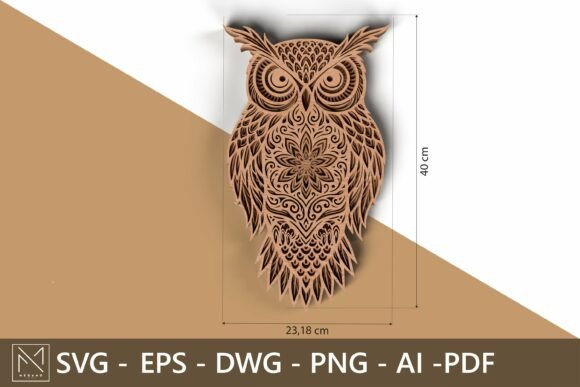
The core value of this design lies in its six distinct layers. Unlike single-pass engravings or simple cutouts, a 6-layer mandala owl relies on the precise alignment of concentric rings and radial elements. Each layer serves a functional purpose: some provide the structural base, others define the primary shapes (such as the wings and facial discs), and the innermost layers add fine textural details like feather patterns or mandala dots.
From a workflow perspective, this structure allows for modularity. You are not fighting against a complex, single-piece geometry that might warp during cutting. Instead, you are managing a series of simpler geometric relationships that, when stacked, produce a high-fidelity result. This approach reduces the risk of material failure during the cutting process and simplifies troubleshooting if a specific layer does not cut cleanly.
Technical Specifications and File Integrity
Efficiency begins with the right assets. This design package is comprehensive, offering multiple formats to suit different stages of the creative pipeline:
- SVG & EPS: Essential for vector editing software like Adobe Illustrator or Inkscape. These formats preserve the mathematical curves of the mandala, allowing for infinite scalability without pixelation.
- DWG & DXF: Crucial for users working with AutoCAD or other engineering-focused CAD programs. These formats ensure compatibility with industrial-grade laser controllers.
- PNG & AI: Useful for quick previews or direct import into raster-based design tools for color grading before conversion to vector paths.
- PDF: A stable format for sharing and printing reference guides, though less ideal for direct laser input unless converted properly.
When importing these files, always verify that all paths are closed and that there are no overlapping unnecessary nodes. Clean vector data is the first step toward consistent quality control in any laser cutting operation.
Material Selection and Compatibility
The success of a 3D layered project is heavily dependent on material choice. The Mandala Owl design is optimized for materials that hold their shape under heat and have uniform density. Understanding how your chosen medium interacts with the laser beam will dictate your power and speed settings.
Wood and MDF
Natural wood offers the most authentic "woodland elegance" intended by the design. Birch plywood is often preferred for its tight grain and lack of knots, which ensures clean cuts through the intricate mandala details. Medium Density Fiberboard (MDF) provides a smooth, consistent surface that accepts finishes well, though it produces more smoke residue. When cutting wood, be mindful of kerf width—the physical width of the laser beam removes material. If your layers are designed to fit tightly together, you may need to adjust the spacing in your vector software to account for this loss.
Acrylic and Cardstock
Acrylic can produce a striking, modern look with vibrant colors, but it requires different ventilation and exhaust settings to prevent melting or charring at the edges. For smaller projects or prototyping, cardstock is an excellent low-cost option. It allows for rapid iteration of the assembly process without significant material waste. However, cardstock is prone to warping if the layers are too large or if humidity affects the paper fibers.
Workflow Integration: From File to Final Assembly
Integrating this asset into a daily workflow involves several distinct phases: preparation, execution, and post-processing. Adhering to a structured process minimizes errors and maximizes productivity.
Phase 1: Preparation and Scaling
The standard dimensions provided are 40 cm in height and 23 cm in width. Before sending the file to the laser cutter, determine your final scale. If you are resizing the design, ensure you do so proportionally to maintain the integrity of the mandala’s symmetry. Use the "Resize" function in your vector editor rather than manually dragging corners, which can distort aspect ratios.
Create a test cut on scrap material. This step is non-negotiable for quality assurance. Check the following:
- Cut Depth: Ensure the laser has fully penetrated each layer without burning excessively into the bottom sheet.
- Kerf Compensation: Verify that the tabs holding the inner pieces in place are strong enough to remain attached until manual removal.
- Alignment Marks: If the design includes registration marks, confirm they are visible and accurate after scaling.
Phase 2: Machine Setup and Execution
This design is compatible with a wide range of machines, including Glowforge, xTool, K40, and Epilog lasers. Regardless of the brand, the underlying physics remain the same. Focus on air assist settings; adequate airflow keeps the lens clean and blows away debris, preventing back-burning on the reverse side of the cut pieces.
Organize your material on the bed efficiently. Since the design consists of six separate layers, you may choose to cut them sequentially or stack them if your machine supports multi-layer processing (though sequential cutting is generally recommended for precision). Label each sheet clearly to avoid confusion during the sorting phase.
Phase 3: Post-Processing and Assembly
Once the cutting is complete, the assembly phase transforms the flat sheets into a 3D object. This is where patience and attention to detail pay off.
Cleaning: Remove all loose chips and soot from the cut edges. A soft brush or compressed air works well here. Residue left in the crevices of the mandala pattern can interfere with the visual clarity of the final piece.
Stacking Strategy: Begin with the largest, outermost layer as your base. Place subsequent layers on top, aligning them carefully. Many users employ double-sided tape or a temporary adhesive spray to hold layers in place while gluing. Alternatively, if the design includes interlocking tabs, slide them together gently. Avoid using excessive glue, which can seep out and ruin the clean lines of the artwork.
Finishing Touches: To enhance the "woodland" aesthetic, consider applying a matte sealant or a light stain to the wood. This protects the material and brings out the natural grain. If using acrylic, a flame polish on the edges can restore transparency and give a professional, glass-like finish.
Strategic Use Cases and Market Applications
Understanding where this product fits in the broader market helps in planning inventory and marketing efforts. The Mandala Owl SVG – 3D Laser Cut Art is versatile enough to serve multiple niches.
Educational Tools
For educators, this design serves as an excellent case study in geometry, symmetry, and spatial reasoning. Students can analyze the radial symmetry of the mandala and understand how 2D vectors translate into 3D structures. It bridges the gap between theoretical math and tangible creation.
Corporate Gifting and Branding
Small businesses can leverage this design for unique branded merchandise. By replacing the traditional owl features with company logos or specific color schemes (via stained wood or colored acrylic), companies can create memorable, high-value gifts for clients. The perceived value of a handmade, 3D object is significantly higher than that of a standard printed item.
Home Décor and Seasonal Sales
The woodland theme resonates strongly with autumn and winter décor trends. As a wall art piece, it adds texture and depth to a room without requiring heavy framing. Entrepreneurs selling at craft fairs or online marketplaces should highlight the "handmade" and "customizable" aspects of the product. Offering size variations—scaling the 40cm version down for nursery decor or up for statement pieces—allows for price tiering and appeals to a wider customer base.
Conclusion on Implementation
The Mandala Owl SVG – 3D Laser Cut Art is more than a downloadable file; it is a blueprint for creating a cohesive, aesthetically pleasing object. Success depends on respecting the design’s complexity through careful material selection, precise machine calibration, and methodical assembly. By treating the workflow as a series of interconnected steps—from vector cleanup to final finishing—you ensure that every unit produced meets high standards of quality. Whether used for personal enjoyment, educational purposes, or commercial gain, this design offers a rewarding challenge that results in a timeless piece of functional art.