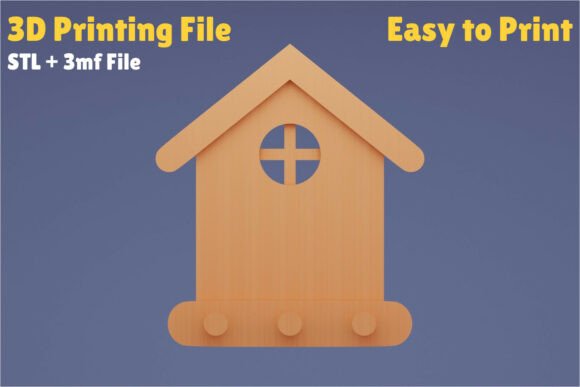
Wall Key Holder 3D Print Model
Let’s be honest: losing your keys is one of the most universal, frustrating experiences in modern life. Whether you are rushing out the door for a morning meeting, heading home late at night, or just trying to find your house keys while holding groceries, that moment of panic when you can’t see them is all too familiar. The solution doesn’t always have to be expensive hardware or complex smart locks. Sometimes, it is as simple as having a dedicated, visible spot right where you need it.
This is where the Wall Key Holder 3D Print Model comes into play. It is not just another piece of plastic on your wall; it is a practical, customizable organizational tool that bridges the gap between clutter and convenience. Designed specifically for ease of use and aesthetic flexibility, this model allows you to create a personalized entryway station without the hassle of traditional installation methods. By leveraging the power of additive manufacturing, you get a product that fits your specific space, style, and key count perfectly.
Why This Design Stands Out
The primary appeal of this particular 3D print model lies in its simplicity and its compatibility with accessible technology. Many 3D printed objects require supports, which means post-processing time—removing those extra bits of filament is tedious and can damage the surface finish. However, this design was engineered to print without support, making it an ideal project for beginners and seasoned makers alike.
When we talk about printing this on a machine like the Bambu Lab A1 Mini, we are talking about precision meets efficiency. The A1 Mini is known for its speed and reliability, and when paired with Esun ePLA Matte filament, the result is a high-quality object that feels substantial and looks professional. The matte finish hides layer lines beautifully, giving the key holder a smooth, almost ceramic-like appearance rather than the typical "plastic" look associated with 3D prints. This is crucial because you will likely be mounting this in a high-traffic area like an entryway, where aesthetics matter.
Real-World Scenarios: Where and Why You Need It
Understanding the utility of the Wall Key Holder 3D Print Model requires looking at different lifestyles. Here is how various users integrate this tool into their daily routines.
The Remote Worker and Digital Nomad
If you work from home, your entryway is often the boundary between your professional and personal life. For remote workers, keeping a tidy workspace extends to keeping a tidy entrance. Cluttered hooks by the door can subconsciously signal chaos. A sleek, wall-mounted key holder keeps your car keys, office badge, and mail organized. Because this model mounts using strong double tape or glue, you don’t have to worry about drilling holes in rented apartments or delicate wall surfaces—a common concern for freelancers and digital nomads who move frequently or live in shared spaces.
The Busy Parent
For parents, the morning routine is a battle against entropy. Kids’ backpacks, lunchboxes, sports gear, and multiple sets of keys can pile up quickly. A robust key holder provides a single, designated zone for the family’s essential access items. When everyone knows exactly where the keys go, the "where are my keys?" search party is eliminated. The durability of PLA Matte ensures that even if a child bumps into it or drops a heavy set of keys, the holder remains intact and functional.
The Small Business Owner and Retailer
Consider a small boutique, a coffee shop, or a co-working space. These environments benefit greatly from branded or custom-designed organizational tools. While off-the-shelf holders exist, they lack character. Printing your own key holders allows you to customize the loop shapes, colors, or even add subtle branding elements. For a business owner, this is a low-cost way to enhance customer experience by providing a welcoming, organized entry point. It signals attention to detail and care for the customer’s convenience.
Technical Execution: Getting the Best Result
To truly appreciate the value of the Wall Key Holder 3D Print Model, you need to understand the settings that make it work so well. The provided STL and 3MF files are optimized for specific parameters, particularly when using the Bambu Lab A1 Mini with a 0.4 mm nozzle. Here is a breakdown of why these settings matter and how they translate to real-world quality.
- No Support Required: The geometry is designed with overhangs that allow the printer to bridge gaps effectively. This saves time and eliminates the risk of damaging the print during cleanup.
- Sparse Infill (3%): You might wonder if 3% infill is enough. For a key holder, absolutely. Keys do not exert downward pressure that would crush a sparse lattice. This setting reduces material usage and print time significantly without compromising structural integrity.
- Layer Height (0.20 mm): Using a standard 0.20 mm layer height with a 0.4 mm nozzle strikes the perfect balance between speed and surface quality. It is fast enough to print multiple units but fine enough to ensure the loops are smooth and won’t snag on keychains or fabric loops.
- Material Choice (Esun ePLA Matte): Standard glossy PLA can look cheap in a home environment. The matte filament diffuses light, reducing the visibility of any minor imperfections and providing a premium tactile feel.
Installation Without the Hassle
One of the most significant advantages of this model is the mounting method. Traditional key racks often require screws, anchors, and a drill. If you are renting, or if you simply dislike the idea of leaving permanent holes in your drywall or tile, this alternative is superior.
Using a high-quality double-sided adhesive tape (such as VHB tape) or a strong construction adhesive allows you to mount the holder securely. The flat back of the 3D print model provides ample surface area for adhesion. Before applying, ensure the wall surface is clean, dry, and free of dust or grease. Press firmly for 30 seconds and let the adhesive cure for 24 hours before hanging your heaviest keys. This method is removable, leaving no trace behind when you decide to move the holder or take it down.
What to Consider Before You Print
While the process is straightforward, there are a few practical considerations to keep in mind to ensure success.
- Wall Surface Compatibility: Adhesive works best on smooth, non-porous surfaces like painted drywall, glass, metal, or tile. On textured wallpaper or rough brick, the bond may not hold the weight of multiple keys. Test a small strip first.
- Key Weight Distribution: Even though the print is strong, avoid hanging excessively heavy industrial keys or large bundles of keys on a single loop. Distribute the weight across multiple loops or choose a thicker filament version if you anticipate heavy use.
- Orientation: Ensure you orient the model correctly in your slicer software. The loops should face outward or downward depending on your preference, but the flat mounting surface must be parallel to the bed or wall.
- Calibration: Always run a basic calibration print on your Bambu Lab A1 Mini before starting a larger batch. Ensuring your flow rate and temperature are correct for Esun ePLA Matte will prevent issues like stringing or weak layers.
Conclusion
The Wall Key Holder 3D Print Model is more than just a file you download; it is a solution to a daily friction point. By combining smart design with accessible 3D printing technology, it offers a cost-effective, aesthetically pleasing, and highly functional way to organize your life. Whether you are a hobbyist enjoying the satisfaction of a successful print, a parent seeking order in chaos, or a business owner looking to add a touch of professionalism, this model delivers. With the right settings and materials, you can produce a durable, support-free key holder that transforms a cluttered entryway into a streamlined, efficient space.