Scientific Experiment 3D Set 03: Integrating High-Fidelity Lab Assets into Professional Workflows
In the modern digital landscape, visual communication is no longer just about aesthetics; it is about clarity, engagement, and trust. Whether you are an educator designing a curriculum, a marketer creating content for a health-tech brand, or a developer building an interactive e-learning platform, the quality of your visual assets directly impacts how your audience perceives your message. This is where Scientific Experiment 3D Set 03 enters the workflow. It is not merely a collection of images; it is a structured library of high-fidelity 3D laboratory elements designed to streamline the production process for science-related content.
This set addresses a common bottleneck in creative and educational projects: the lack of accessible, realistic, yet engaging scientific imagery. Traditional stock photography often feels sterile or overly staged, while generic clip art lacks the depth required for professional presentations. Scientific Experiment 3D Set 03 bridges this gap by offering a bright, modern, and detailed collection of lab tools that can be seamlessly integrated into various digital and print workflows.
The Core Components of the Asset Library
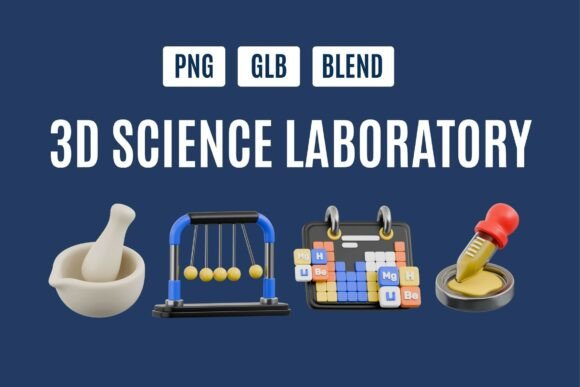
To understand how to implement this resource effectively, one must first look at what constitutes the bundle. The set is built around twenty distinct 3D science and laboratory elements. These are not static JPEGs but versatile files available in multiple formats to suit different stages of the production pipeline.
- PNG Files: Four high-resolution PNG files with transparent backgrounds are included. These are ideal for immediate drag-and-drop use in graphic design software like Adobe Photoshop, Canva, or Figma. The transparency allows these elements to sit naturally over any background without the need for tedious masking.
- GLB Files: Four GLB (glTF Binary) files provide lightweight, web-ready 3D models. These are perfect for integration into web browsers using libraries like Three.js or for viewing in AR/VR applications. They allow end-users to rotate and inspect the objects, adding an interactive layer to educational materials.
- Blend Files: For designers who require full control over lighting, camera angles, and textures, four Blender (.blend) source files are provided. This allows for deep customization, ensuring that the assets match the specific color palette and rendering style of your existing project.
Each element—from colorful beakers and microscopes to test tubes, molecules, and DNA models—is crafted with smooth shapes, vibrant colors, and professional lighting. This attention to detail ensures that the visuals look both realistic and playful, striking a balance between scientific accuracy and approachable design.
Strategic Integration into Creative and Educational Workflows
The true value of Scientific Experiment 3D Set 03 lies in its versatility across different phases of a project. Rather than being a one-off asset, it serves as a foundational component in broader content strategies.
Pre-Production and Concept Development
Before a single frame is rendered or a page is laid out, creators often engage in mood boarding and concept sketching. Using the PNG versions of these 3D elements allows designers to quickly visualize how scientific concepts will look in their final composition. Because the assets feature soft lighting and smooth finishes, they provide a reliable reference for how light interacts with glass and plastic surfaces. This helps in planning the overall lighting scheme of a project, ensuring consistency between the new assets and any other photographic elements used.
Digital Content Creation and Social Media
For marketers and social media managers, attention spans are short. Static images must convey complex ideas instantly. The vibrant colors and clean geometry of the 3D models in this set are optimized for digital screens. When creating YouTube thumbnails, Instagram posts, or LinkedIn articles related to science, technology, engineering, and mathematics (STEM), these assets stand out against typical flat designs. The "fun" and "innovative" vibe mentioned in the product description is crucial here; it lowers the cognitive load for the viewer, making scientific topics feel more accessible and less intimidating.
Furthermore, the transparent backgrounds eliminate the need for post-processing time. In a fast-paced agency environment, saving hours on image editing translates directly to higher efficiency and faster turnaround times for client deliverables.
E-Learning and Interactive Education
For educators and instructional designers, the inclusion of GLB and Blend files opens up advanced possibilities. Instead of embedding a static image of a DNA helix, teachers can embed an interactive 3D model that students can rotate to view from different angles. This active engagement improves retention rates compared to passive reading. The high-resolution nature of the assets ensures that even when zoomed in on a tablet or smartphone screen, the details remain crisp, which is essential for mobile-first learning platforms.
Print Materials and Infographics
While digital is dominant, print remains vital for academic conferences, classroom posters, and corporate brochures. The high-resolution PNGs ensure that when these 3D elements are placed in vector-based layouts (such as those created in Adobe Illustrator), they retain their sharpness. The professional lighting applied to the renders means that shadows and highlights are baked in correctly, reducing the risk of visual inconsistencies when combined with other graphical elements.
Technical Considerations for Seamless Implementation
Integrating 3D assets into a workflow requires attention to technical details to maintain quality and file management hygiene. Here are practical tips for working with Scientific Experiment 3D Set 03.
File Organization and Naming Conventions
With multiple formats (PNG, GLB, BLEND) for each of the twenty elements, file organization is critical. Create a dedicated folder structure within your project directory. For example, separate folders for "Source Files," "Web Assets," and "Print Ready" help team members find the correct version quickly. Consistent naming conventions, such as Lab_Beaker_01_Render.png, prevent confusion during collaborative projects.
Compatibility and Software Requirements
While the PNG and GLB files are widely compatible, the Blend files require Blender. Ensure that all team members have access to a recent version of Blender to avoid compatibility issues with newer features or modifiers. If your team uses other 3D software like Cinema 4D or Maya, the GLB format serves as a universal exchange standard, allowing for easy importation and texture mapping adjustments.
Consistency in Lighting and Style
One of the strengths of this set is the pre-applied professional lighting. However, if you choose to modify the lighting in Blender, be mindful of maintaining consistency across all assets. Mixing heavily shadowed elements with brightly lit ones can create a disjointed visual experience. Use the original renders as a baseline for color grading and exposure when integrating them into larger compositions.
Long-Term Value and Scalability
Investing in a comprehensive 3D asset library like Scientific Experiment 3D Set 03 offers long-term scalability. As your brand or educational institution grows, the need for consistent visual language increases. Having a standardized set of high-quality 3D elements ensures that whether you are producing content today or five years from now, the aesthetic remains cohesive. This consistency builds brand recognition and trust among your audience.
Moreover, the modular nature of these assets allows for repurposing. A microscope render used in a blog post header can be adapted for a slide deck thumbnail or a website banner with minimal effort. This flexibility maximizes the return on investment for the asset pack, turning a single purchase into a reusable resource for multiple campaigns and projects.
Conclusion
Scientific Experiment 3D Set 03 is more than a decorative add-on; it is a functional tool for enhancing communication in science and education. By providing high-quality, versatile, and professionally rendered assets, it empowers creators, educators, and marketers to produce content that is both visually stunning and intellectually engaging. Whether you are building an interactive web experience, designing a classroom poster, or crafting a social media campaign, integrating these 3D elements into your workflow can significantly elevate the quality and impact of your work. Embrace the blend of realism and playfulness that this set offers, and watch as your scientific content becomes more accessible, memorable, and effective.